
Showing posts with label Historic Rallying. Show all posts
Showing posts with label Historic Rallying. Show all posts
Friday, January 18, 2013
Shedding Some Light on the Matter: An Illuminating Evolution

Thursday, January 10, 2013
That Time of Year Again
Well it appears to be that time of year again when we engage in ritual combat with Porsches, Alfa Romeos, Jaguars and other automotive iron on the Rallye Monte Carlo Historique. It's come around very fast. I'm now madly making pace notes and doing a million things before I fly out to to fettle and calibrate the car next week. This time the "off" is from Monte Carlo on Monday 28th January and finishes at the same place in the early hours of Saturday 2nd February. A good place to spectate is the Quai Albert, MC, at the start of the Turini night loop on the afternoon of Friday 1st February or a little later at the top of the Col de Turini itself. Please come and watch if you are anywhere near the south of France or come and say hello after the finish. I won't bore you with more details now as everything will get published in the motoring press anyway (thanks Jeff)but in the meantime here are a few nice action snaps of the MiniSpares-Mad Dog Rally Team on the 2012 event.


Oh and you can follow us on Facebook and Twitter, too.


Friday, January 29, 2010
Rallye Monte Carlo Historique
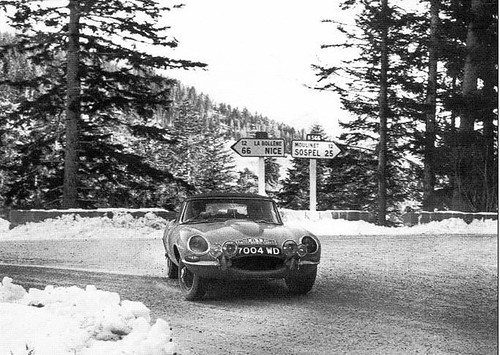
A classic photo of the E type Jaguar of Merrick and Merrick in opposite lock across the top of the Col de Turini on the 1962 MCR. They appear to have driven over the mountain in the reverse direction from La Bollène Vésubie and instead of heading down to Sospel and back to Monte Carlo, look to be going straight ahead to Peira Cava and then facing the Col de Braus and the Col de L'Orme before getting any rest.
As I write, the Monte Carlo Historique rally has just started. This year, unfortunately, I am not seated in my trusty Mini Cooper at Reims waiting for the off. There are too many other things on my "to do" list. Even so, I feel left out and I don't make a good spectator. Next year Bill and I will be back with a vengeance. 2011 is the 100th anniversary of the event and it will be a serious party. And needless to say we expect to be on the winners' podium at the end!
Friday, November 20, 2009
Fivolous Friday: The Flying Finns
Just a quickie today. I've borrowed the idea from Chuck Goolsbee. It's a YouTube clip of Finnish rally drivers attempting deforrestation with their cars. Be warned, the wholesale destruction of some classic machinery, not to mention trees, telegraph poles and spectators, is sometimes hard to watch. But I guess this is what happens when you live through winters where there are only four hours of daylight every day. To avoid depression you can either drink industrial strength potato vodka or go rallying. Having seen Finnish rally drivers attack stages at 11/10 in the most atrocious conditions I confirm that they are fearless maniacs when it comes to competitive driving. Timo Mäkinen and Rauno Aaltonen were both products of this system. By the way, did you notice that the only car to come through that carnage unscathed was a Mini Cooper…? Enough said, enjoy the clip.
Sunday, November 01, 2009
NW Classic Rally
As an addendum to previous post on the NW Classic Rally, here's a couple of YT clips. The first is a photo montage of the event made by the rally organizers. The second is a short segment shot by me through the windshield of the car as we blasted through the beautiful Oregon countryside. Enjoy!
Montage of the 2009 NW Classic Rally; the Dave Matthews Band provides a pleasing soundtrack
Co-driver's view as we push on hard: the inline 6 provides an even more pleasing soundtrack
Montage of the 2009 NW Classic Rally; the Dave Matthews Band provides a pleasing soundtrack
Co-driver's view as we push on hard: the inline 6 provides an even more pleasing soundtrack
Friday, October 30, 2009
What We Did on Our Holidays. Part 3: The other "Monte"
If you've been reading my previous posts, you will know that I spent much of July of this year preparing for the NW Classic Rally. This event is run by the Oregon Alfa Romeo club and has established itself as one of the most popular Time Speed Distance or Regularity rallys for classic cars in the US. The objective is not to race but maintain precise average speeds (although I can't deny a little, er hum, spirited driving does occur). Overall, while being a serious event, it's great fun and has none of the brutal challenges of something like the Monte Carlo Historique. Interestingly the rally's major sponsor is Portland Jaguar dealer, Monte Shelton, so I came to refer to it as "The other Monte...". Below is a photo essay of this year's 21st NW Classic. The less said about the results the better, but it was Olivia's first rally and our first together as a team. In addition the rules are a lot different from the Monte Carlo and we were on a steep learning curve. But we had a great time, made new friends and most of all zoomed about with the spectacularly beautiful Oregon countryside with great panache in our Great Green Cat...
Note: additional photos from Chuck Goolsbee, Olivia Morrow and the NW Classic Rally organization.

The "Shaguar" dressed up to prior to leaving for Portland

We meet up with another E type custodian and blogger from the Seattle area, Chuck Goolsbee, along with his co-driver father, and drive to Portland in convoy
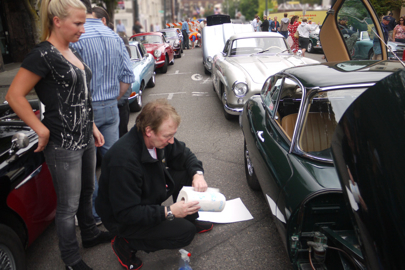
MD applies stickers prior to technical scrutineering. Olivia supervises

Mel Muzio and team did a great job in preparing the car -thanks again, Mel
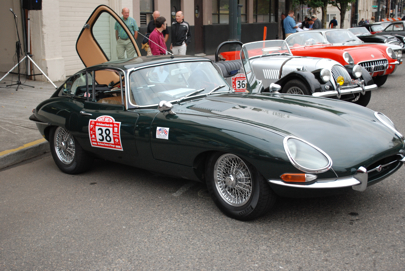
Stickered up and ready for the start

Olivia is excited
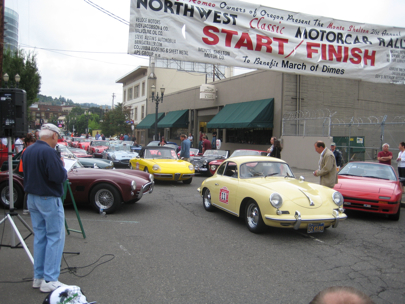
The Start in downtown Portland
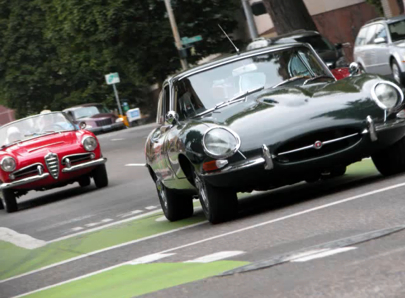
Off and running at last -the E type is moody and purposeful
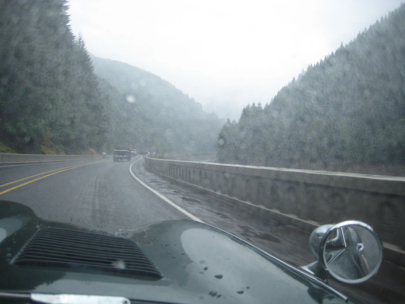
Fighting the elements and motoring hard behind the clock
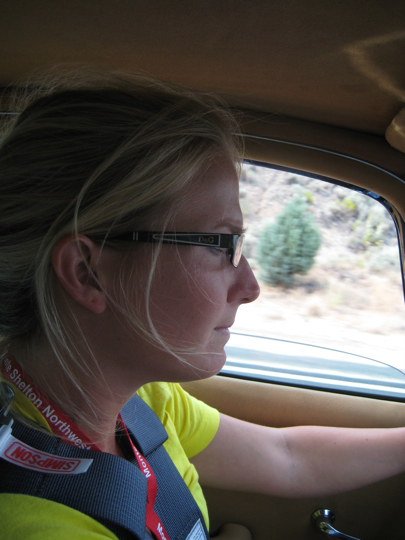
Olivia is determined to make up time
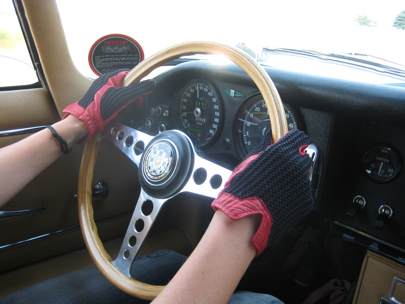
Her right foot is well in...
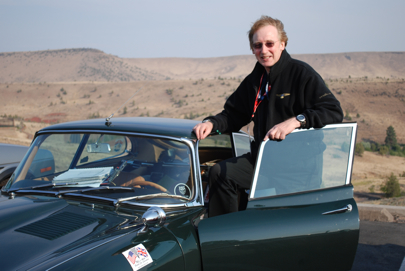
Getting ready for a loop around the high desert on Day 2
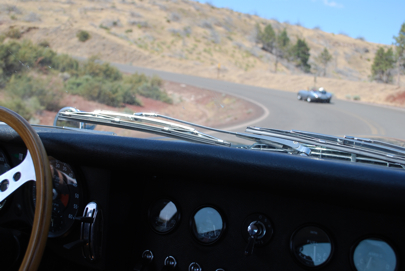
Clipping an apex
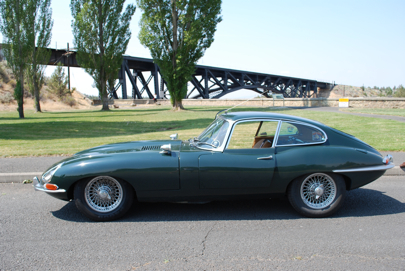
Lunch stop (i)
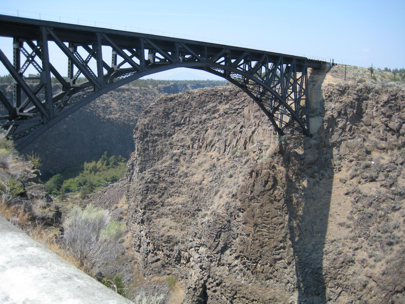
Lunch stop (ii) -that gorge is spectacular
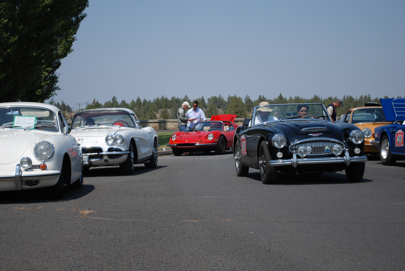
Lunch stop (iii) -how many cars can you name? [Not you, CG]
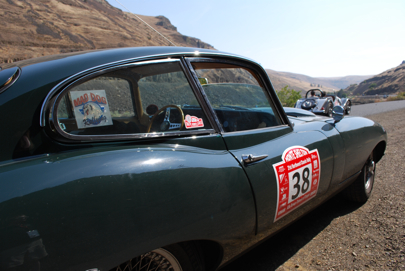
Waiting for our off time at the start of yet another regularity section
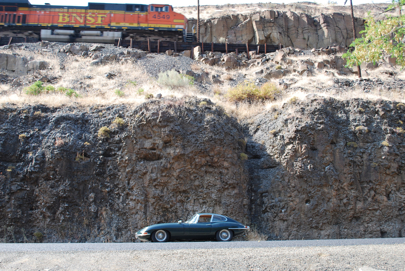
If a train leaves a station and travels at an average speed of 50mh and a car driving in the opposite direction leaves a checkpoint at 47mph, at what time will they...?

MD team happy: we'll be back next year!
Note: additional photos from Chuck Goolsbee, Olivia Morrow and the NW Classic Rally organization.
The "Shaguar" dressed up to prior to leaving for Portland
We meet up with another E type custodian and blogger from the Seattle area, Chuck Goolsbee, along with his co-driver father, and drive to Portland in convoy
MD applies stickers prior to technical scrutineering. Olivia supervises
Mel Muzio and team did a great job in preparing the car -thanks again, Mel
Stickered up and ready for the start
Olivia is excited
The Start in downtown Portland
Off and running at last -the E type is moody and purposeful
Fighting the elements and motoring hard behind the clock
Olivia is determined to make up time
Her right foot is well in...
Getting ready for a loop around the high desert on Day 2
Clipping an apex
Lunch stop (i)
Lunch stop (ii) -that gorge is spectacular
Lunch stop (iii) -how many cars can you name? [Not you, CG]
Waiting for our off time at the start of yet another regularity section
If a train leaves a station and travels at an average speed of 50mh and a car driving in the opposite direction leaves a checkpoint at 47mph, at what time will they...?
MD team happy: we'll be back next year!
Wednesday, January 16, 2008
Time, Speed, Distance
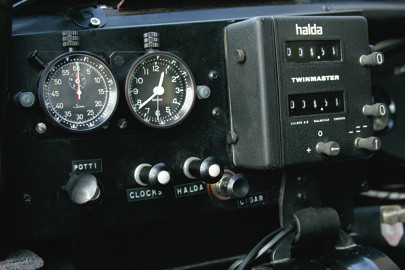
Mad Dog's on-the-road "office"
Various friends, colleagues and some bloggers have asked me what rallying is all about. The realisation that I'm regarded as an authority in some quarters is quite funny but I suppose I have learned a bit since my first, laughably useless, first attempt on one of the first days of the New Millennium. So here's a quick guide for the perplexed.
The overall objective of historic or classic rallying is to drive a specified route and collect the fewest penalty points. A few things are assumed (i) that a car must have a crew of at least two individuals and (ii) an age-appropriate vehicle must be used. Different organisations and different events will have varying rules which is quite confusing, especially when they dictate the modifications that can be made to the car or the equipment carried. Roughly speaking, the car needs to have only period modifications although some concessions are allowed for safety (modern seats, seatbelts, roll cages etc).
So as I was saying, the crew needs to drive from the start to finish along a pre-defined route in a timely manner. To ensure this happens, the rally organisers will set up check points to ensure that the competitors are not cheating and taking shortcuts. The crews must get to certain time controls on the exact minute as written in the instructions. This is usually not too difficult, especially if the section is longish -the organisers usually build in sufficient time to allow the crews to stop for fuel, take "bio-breaks" get coffee or do minor servicing and repairs. So the general idea is to get to a spot before the checkpoint (often conveniently located in a café) early and then check exactly on the prescribed minute (a task for the co-driver). An important point to make is that historic rallies are conducted at street legal speeds and are not races (usually). It's actually bad form to call the event "a race" as it gets the sport a bad name. The point is not to reenact the Gumball Rally. The American term "rally racing" is also misleading. It's fine for WRC kind of thing where the fastest through the stage wins but it's not what historic events are about.
OK, I hope that's clear so far. But I've only covered the easy part known as "transit sections". Up until now all that's needed is a competent driver and co-driver, the ability to drive to a route and organise the car to be at certain places on time. Surprisingly a lot of people get tripped up on the transit sections and if the rally planners scatter a few navigational booby traps in the mix a lot of crews can get caught out. But now the fun rally begins. The point of the transit sections is to convey the crews to the really nasty bits which are known as "Regularity Zones". Americans call this next bit Time, Speed, Distance which is a good description. At the starting checkpoint the crew will be assigned a speed. They then have to drive the route precisely at this average speed, usually between 42-49 KPH. The regularity stages vary in length from 10-40 kilometers. The degree of precision is variable from event to event but this year the Automobile Club de Monaco is doing the timing to 1/100th of a second! So how is this accuracy accomplished? Well the co-driver needs three items (i) a good stopwatch, (ii) an accurate mechanical tripmeter of the type used in the 60s and 70s -the Mini is fitted with a Halda Twinmaster; these devices were originally made for Swedish taxis and are accurate down to 10 metres and (iii) a large book of speedtables. Lots of excellent geekery is involved. As soon as the car is flagged off, the previously zeroed stopwatch and tripmeter are started and the co-driver starts checking the average speed in the book by cross reading elapsed time on the stopwatch vs. distance covered on the tripmeter. I try to do this four times per minute and call out whether we are fast or slow. If the car is bouncing over a bad road it's quite common to be able to achieve only two or three sampling times per minute. Oh, and the co-driver has also got to keep the driver on the correct route so some map work is necessary too. And before anybody asks, modern electronic tripmeters are illegal as are GPS devices and other such gizmos. Some rallies outlaw the use of mobile phones (one or two competitors phone back road conditions and positions of hidden intermediate timing points -usually a couple of marshals sequestered in a van- to their team mates) but it's virtually impossible to police their use. The ACM doesn't even try.
So just in case anybody is thinking that maintaining an average speed of less than 30mph is easy, let me point out that the stages are invariably narrow mountain roads frequently covered with snow and ice. Freezing fog is quite common too. To do well everything needs to be just right. The crew must have a harmonious relationship with each knowing their precise job, the car needs to be set up correctly and in the case of the Monte Carlo, appropriate tyres need to be fitted and the service crew needs to be at a spot where wheels can be juggled. If any of these variables are wrong, the crew will find the going difficult. Often it's so difficult to make the target time (usually set in optimum weather conditions) that the drive is a flat out blast until the end of the stage.
And that's about it. If you can maintain your concentration for four days, manage to drive all the transit sections on time, score a minimum of penalties on the regularity stages (the Monte Carlo has 14 this year) not crash or breakdown, avoid traffic jams due to bad weather, idiotic spectators or bakers giving away apple strudel* and not come to blows with your crew members**, you'll have a good chance of finishing in the points. In any case you'll have a lot of good stories by the end of the event and the Automobile Club de Monaco holds the best party ever.
P.S. Following a comment from the ever astute Little Cricket, I realised I omitted an important fact about the regularity stages. I should have mentioned how the average speed is monitored. Each car carries a transponder which registers when we start and finish the stage. There are also hidden intermediate timing points to stop cars accruing time on the easier sections and giving themselves a reserve for the harder parts of the stage. I should also out that this year, in an attempt to control the boy racer element in the rally (sadly there is one) the penalty points for being ahead of the target time are six times those for being slow.
* This happened to us in 2005. A baker in the village of Antraigues is famous for passing out delicious apple strudel to the rally crews. Note to the ACM and the local Gendamarie: it's a lovely gesture but please don't let it impede competeing cars. After losing 15 minutes due to crowd control, Iwanted to stick the said strudel up somebody's ar was very stressed.
** Rally lore has several accounts of married couples getting so angry with each other en route that they've abandonded their car, flown home separately and filed for divorce!
* This happened to us in 2005. A baker in the village of Antraigues is famous for passing out delicious apple strudel to the rally crews. Note to the ACM and the local Gendamarie: it's a lovely gesture but please don't let it impede competeing cars. After losing 15 minutes due to crowd control, I
** Rally lore has several accounts of married couples getting so angry with each other en route that they've abandonded their car, flown home separately and filed for divorce!
Subscribe to:
Posts (Atom)